Final Publication Edition 3.1 · research product 1.2.0‑rc3
The numbers that value blockchains are audited by nobody.
Voxonomics is the measurement standard that changes that — one framework, applied identically to every chain, read from the networks’ own records, with the evidence kept for every figure. Where a figure cannot be produced honestly, it is not published.
The dashboard is where the measurements are read. It is not open yet, and that is the same rule the rest of this page follows: official scoring stays disabled until calibration is complete and governance approves it. Until then there is nothing there we would stand behind publishing.
6 × 5equal sixths 30 submetrics
Six equal sixths, each split by its submetrics’ real weights.
Hold and trace the ring — each one names itself as you cross it.
All thirty against the clock; leave the ring and you start again.
Parent indices
6
Submetrics
30
Networks in scope
3
Scores published
0
The problem
Everyone quotes the figures. Nobody can check them.
Ask how large a blockchain’s economy is and you will get a confident number within seconds. Ask where that number came from and the trail runs out almost immediately.
These are not obscure statistics. They decide where treasuries allocate capital, which networks get built on, and what is written into research notes and regulatory filings. They are quoted with the authority of audited accounts and produced with none of the discipline.
“This chain has $4 billion locked.”total value locked
Locked by whose definition? Counted once, or once again for every wrapper it passes through? The figure moves by billions depending on choices a reader never sees.
“It has 900,000 active users.”active addresses
Addresses are not people. One person can hold thousands; one bot can hold millions. Nothing published tells you which you are looking at.
“It did $20 billion in volume.”trading volume
Volume includes trades made purely to inflate volume. Filtering those out is a judgement call, and almost nobody publishes the rule they used.
“It earned $30 million in fees.”protocol revenue
Earned by the network, or by applications built on top of it? Before or after what is burned or paid out? Two sources will disagree by an order of magnitude.
The deeper problem is that every network is measured on its own terms. A figure from one chain and a figure from another are not comparable, even when they share a name — so the comparison everybody makes is one that nobody can justify.
What we are building
The instrument itself.
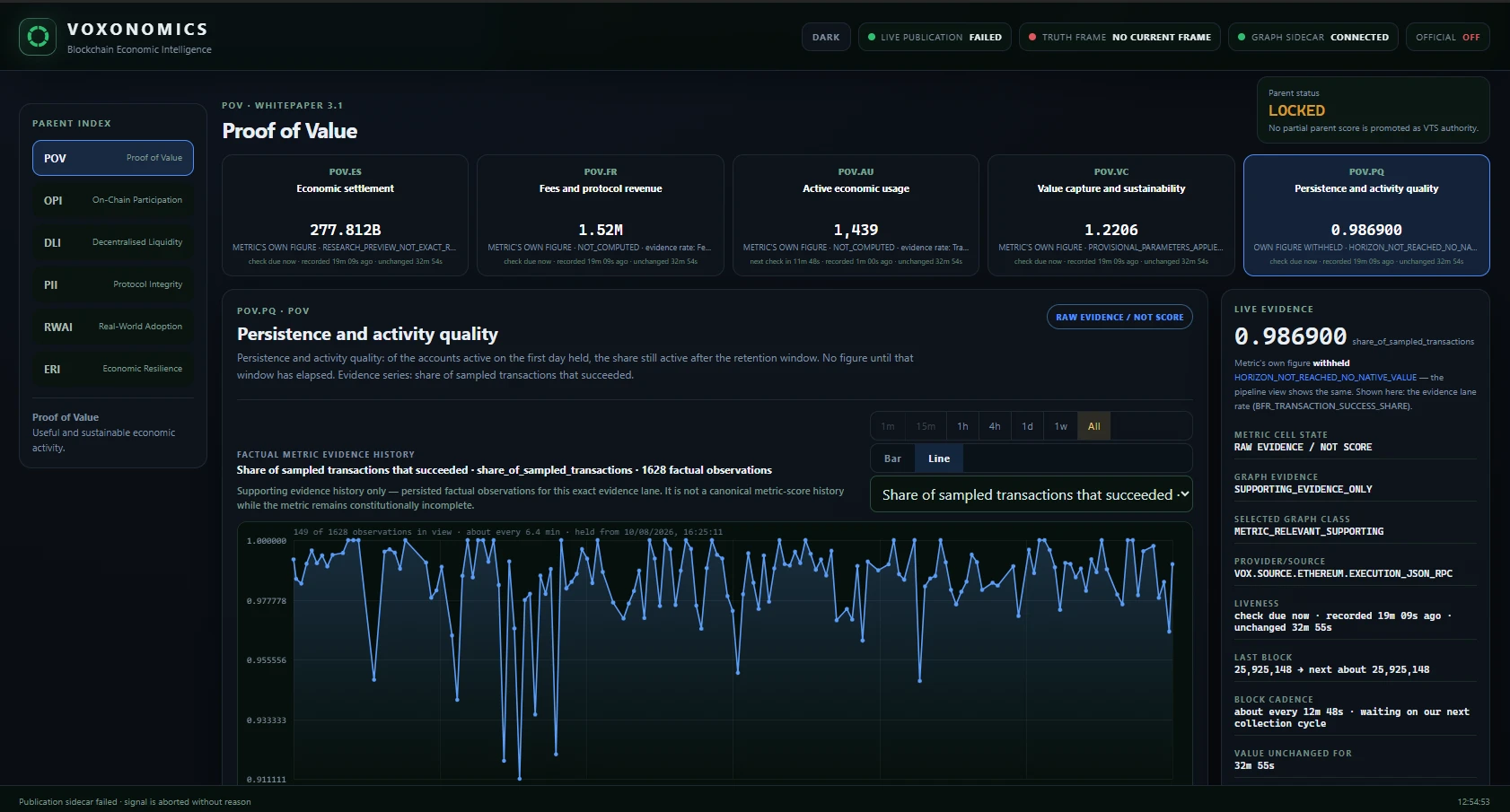
This is the terminal that runs the measurement lanes — a screenshot of it, not an impression of it. Proof of Value is open: its five submetrics along the top, one evidence series charted below, and that observation’s provenance beside it — source, last block, block cadence, and how long the value has stood unchanged.
Read what it says about itself. The parent status is LOCKED, and it explains why in its own words: no partial parent score is promoted as VTS authority. The selected metric’s own figure is withheld, because its retention window has not elapsed. The chart is badged RAW EVIDENCE / NOT SCORE and says underneath that it is supporting evidence history only, not a canonical metric-score history while the metric remains constitutionally incomplete. The official switch reads OFF.
That is the instrument refusing to overstate itself, without anyone asking it to. It is the same refusal the pipeline below takes apart step by step.
A research build on a developer machine, captured as it stood.
The terminal as it runs. Captured 8 October on a research build, which is why two of its own connections report failed — that is left in. One thing is altered: the mark in the corner, which the capture predates, is the current one. Shown at this width: the provenance panel from the right of that screen.
How a number is made
Watch one measurement being built.
Every figure travels the same five steps: read the blocks, check what is actually in them, collect only what the definition asks for, run the equation, and out comes a number — which stops at a gate until it has been calibrated and approved. Nothing passes that gate today.
the chips in each stretch are the real count at that stage — click to shove more in, none of it fitsonly what the run found gets through
The lane page runs this on a real submetric — venue and asset diversity — with the arithmetic live, what the specification asks for against what the evidence answers, and the same lane refusing on a network that cannot support it.
The standard
One framework, applied to every chain, with the receipts kept.
Voxonomics measures blockchain economies the way a laboratory measures anything else: from primary evidence, under a published method, in stated units, with the working preserved so somebody else can repeat it and get the same answer.
Commitment 01
Read the source, not a summary
Figures come from the networks’ own blocks, transaction receipts and event logs — the raw record the chain itself produces — not from a data vendor’s interpretation of them. Every reading keeps the exact block range it covered and a fingerprint of the bytes it read.
Rule 3 — real, verifiable data only
A figure that cannot name the blocks it came from cannot be admitted. This is why prices lost to a machine outage were recovered from oracle answers and pool trades already held in our own blocks, rather than fetched from a price API afterwards.
Commitment 02
Treat every network the same
The same six indices, the same thirty submetrics, the same equations, on every chain. Where a network’s architecture genuinely differs, the adapter that reads it differs — the definition it must answer does not.
Rule 7 — chain-specific code only for chain-specific evidence
Avalanche is measured on Ethereum’s definitions with no allowance for being smaller. Where Solana cannot answer a definition, it is refused by name rather than given an easier one.
Commitment 03
Say so when you cannot measure
A gap in the evidence is reported as a gap. It is never quietly filled with an estimate, an industry average, or a neutral placeholder that flatters the result. The reason is published in the figure’s place.
Rule 4 — no placeholders, ever
The clearest case: a plausible Solana liquidity figure existed internally and was withdrawn before publication, because it would have described the size of a filter rather than the breadth of a market.
The method
How a single number is made.
Every figure travels the same five stages. They are deliberately separate, so that measuring something and scoring it never happen in the same step.
Provenance recordstage 01
The record is the product. Every field is filled from the reading itself — what you see here is the shape of the record, not a measurement.
01Stage 01
Evidence
Read the chain, not a report of it.
Blocks, transaction receipts and event logs, taken from the network’s own nodes. The exact block range and a fingerprint of the bytes are kept, so anyone can repeat the reading and get the same answer.
Never a vendor’s summary.02Stage 02
Native value
The real figure, in its real unit.
Dollars settled. Fees paid. Effective operators. The figure is recorded as what it actually is, before anything decides what it is worth.
Never rounded, smoothed, or pre-scored.03Stage 03
State
Say what kind of number this is.
Measured, provisional, or refused — and why. A refusal names the evidence that was missing, which is what makes the gap arguable and, eventually, closeable.
Never a gap filled with an estimate.04Stage 04
Normalisation
Make different units comparable.
Only now are fully measured figures placed on one scale, so dollars, counts and rates can sit inside the same index without one drowning the others.
Never anything that is not fully measured.05Stage 05 · locked
Score
Combine the six indices.
The stage is built and wired, and deliberately switched off. It turns on when calibration is complete and governance approves it — not before.
Not yet: locked until governance.
The separation between stages two and four matters most. Producing a measurement and deciding what that measurement is worth are different jobs, and mixing them is how most published crypto metrics go wrong: a scoring choice gets baked into the figure itself, where no reader can see it or argue with it.
What is kept with every figure
Record structure
network
< the chain the reading was taken from >
block range
< first block > to < last block >
evidence fingerprint
< hash of the exact bytes that were read >
unit
< the real unit — dollars settled, fees paid, effective operators >
state
< measured | provisional | refused >
reason if refused
< the missing evidence, named >
method version
< specification edition and the equation applied >
calculated at
< timestamp of the calculation >
This is the shape of the record, not a reading — no measurements are published on this page. It is what separates a figure that can be checked from one that can only be quoted: anyone holding the record can return to the same blocks and produce the same number, or demonstrate that it cannot be produced.
The framework
Six questions, each carrying exactly one‑sixth of the weight.
A blockchain economy is not one thing, so it is not one number. Voxonomics asks six independent questions of every network, weighted equally, so the framework cannot be tuned to flatter any chain’s strengths. Inside each index, five submetrics carry the fixed weights shown.
Weight of every submetric within its index
Weights are fixed by Edition 3.1. Every index is divided among exactly five submetrics, and the five always total 100%.
The complete register — all 30 submetrics, Edition 3.1Each weight is that submetric’s share of its own parent index, not of the whole framework — the five in every index sum to 100%.
ID
Submetric
Weight in index
Horizon
Direction
Different readers care about different things. A payments company and a validator operator are not asking the same question of a network, and the framework allows their priorities to be weighted differently — but the weights always renormalise to sum to one, so no priority setting can secretly inflate a total.
Trust
Three states, and the third one is the point.
Every figure carries one of three states. What separates Voxonomics from every dashboard in this industry is that the third is treated as a legitimate result and published with the same prominence as the other two.
Measured
The evidence fully answers the definition. The figure is real, in its real unit, and the block range and method that produced it are recorded beside it.
What it looks like
A figure with its block range, its unit and the equation applied recorded beside it. Anyone holding that record can return to the same blocks and produce the same number.
Provisional
A genuine measurement, taken under settings governance has not yet ratified, or over a window still filling. Real, and not yet final.
What it looks like
A real measurement running under settings governance has not ratified. Four lanes are in this state today — built, measuring, and deliberately contributing nothing to any score.
Refused
The evidence does not support the figure the definition asks for. Nothing is published in its place — the reason is named instead, so a reader can judge it and a later release can close it.
What it looks like
An empty cell with a named reason. Solana’s venue diversity reads “the scan does not retain which program a trade was routed through” — a gap you can argue with, and one a later release can close.
This sounds like a limitation. It is the opposite. A dashboard that always has a number in every cell is telling you, whether it means to or not, that it has never once met evidence it could not interpret — which is not a claim any honest measurement system can make.
Here is a real case from the first liquidity measurement built into the system. The figures themselves are withheld pending governance; what matters is the decision, not the numbers.
Venue and asset diversity
DLI.VD · method case · no figures published
Ethereum■ Measurable
The evidence identifies both the venue each trade passed through and the assets that moved — precisely what the definition asks for. The measurement runs.
Avalanche■ Measurable
The same evidence is available, so the same definition is answered by the same equation. No separate rule, no adjusted definition, no allowance made for the smaller network.
Solana□ Refused
The evidence retained cannot identify which venue a trade was routed through, and the assets it does retain are a filtered subset. A count over them would measure the filter, not the market.
A plausible-looking Solana figure had already been produced internally. It was withdrawn before publication, because it would have described the filter rather than the chain — and would have read as a narrow market however broadly Solana actually trades. No substitute value was issued, and nothing appears in its place.
A conventional dashboard would have shipped that figure and moved on. It looks like data. It is precise to two decimal places. It is also, read carefully, an answer to a question nobody asked. Voxonomics publishes the refusal instead — and publishes why — because a named gap can be closed, and a wrong number cannot.
Coverage
Three networks, read continuously, on identical definitions.
The framework is chain-agnostic by construction: adding a network adds an adapter, never a new definition. These three are in scope today.
Ethereum
In scope
Blocks, transaction receipts and event logs read directly from its own nodes, with call traces where the evidence requires them.
RetainsFull blocks and receipts, every event log, and call traces for internal value movement. Beacon-chain validator records.
Can answerSettlement, fees, active accounts by exact account map, security participation grouped by withdrawal credential, venue and asset diversity from the swaps venues emit themselves.
RefusesEntity attribution and independence — no clustering policy exists, so accounts are never asserted to be people.
Solana
In scope
Read per slot. Several definitions are refused by name, because the evidence retained cannot answer them — published as refusals, never as estimates.
RetainsPer-transaction token balance changes carrying the mint and the owner; vote accounts and their node keys; a payer sketch.
Can answerSettlement between the retained mints, fee split by signature, security participation grouped by node key.
RefusesTrading venue — the scan does not keep which program a trade was routed through. Asset diversity — balances are retained only for the settlement stablecoins, so a count would measure the filter, not the market. Raw signers — a payer sketch is held rather than the accounts themselves, so participant breadth is a sketch and the user and application domains are withheld.
Avalanche
In scope
Read on the same definitions as Ethereum, with no allowance made for the smaller network. The same equation or nothing.
RetainsBlocks, receipts and logs from its own nodes; primary-network validator records with their reward owners and delegations.
Can answerSettlement, fees, active accounts, venue and asset diversity, and security participation grouped by reward owner with delegations kept apart from an operator’s own weight.
RefusesThe same entity attribution Ethereum refuses. A smaller network is not given an easier definition.
Every refusal above is a named gap, not a missing feature. It says exactly what evidence would close it.
The constitution
Nine constraints the system is not permitted to break.
These are enforced in the software itself, not held as an intention. Several of them make the product slower, narrower and less impressive than it could otherwise be. That is the trade, made deliberately.
Keep the real value and its real unit
A figure is never converted into a score before it has been recorded as what it actually is.
How it is enforced
Stage 02 of the pipeline records the native value and unit before any normalisation runs. The score stage cannot read a figure that has not been recorded natively first.
Keep measuring separate from scoring
Producing a number and judging that number are different operations, run by different parts of the system.
How it is enforced
Measurement lanes and the scoring engine are separate components. A lane can be complete, running and correct while contributing nothing — four currently are.
Real, verifiable data only
If a figure cannot be traced back to primary evidence, it does not enter the framework.
How it is enforced
Every reading carries the block range it covered and a fingerprint of the bytes read. A figure without that record cannot be admitted.
No placeholders, ever
No dummy values, no neutral substitutes, no industry averages standing in for a missing measurement.
How it is enforced
This is the rule that produced the Solana liquidity refusal. A plausible figure existed internally and was withdrawn rather than published, because it described a filter rather than a market.
The six indices stay equal
Universal and one-sixth each, so the framework cannot be shaped to suit a particular network.
How it is enforced
The six parent weights are fixed in the specification and are not a parameter. Only the five submetric weights inside each index are set, and those are fixed too.
Priorities always renormalise to one
Readers may weight the indices to their own concerns; no weighting can inflate a total.
How it is enforced
Priority points are normalised before they are applied, so any set of reader priorities produces effective weights summing to exactly one.
Chain-specific code only for chain-specific evidence
Networks differ in how they must be read, never in what they are asked.
How it is enforced
Each chain has its own adapter for reading evidence. None has its own definition. Where a chain cannot answer, the answer is a refusal, not a relaxed rule.
Preserve the working
Provenance, revisions, method versions and reproducibility are kept for every figure ever published.
How it is enforced
Records carry the specification edition and the equation applied, so a figure produced under one version stays attributable to it after the method moves on.
Official scoring stays off until it is earned
Live contributions and published scores remain disabled until calibration is complete and governance approves.
How it is enforced
The scoring stage is built and wired, and switched off. Two gates stand before it: calibration against observed ranges, then approval of each parameter package by hash.
Whitepaper & documents
The specification everything here is built from.
Voxonomics is defined by a published specification, not by its software. The code implements the document; where the two disagree, the document wins.
Final Publication Edition 3.1. Defines the six parent indices, the thirty submetrics, their equations, units, horizons and directions, and the rules governing evidence, provenance and exclusions.
The universal metric-to-score parameter set: benchmarks, sensitivity parameters and priority points, held as an editable workbook so governance can reason about a change before it is made.
Metrics, networks, sources, benchmarks and calibration held as structured data with schemas, so the definitions the software runs are the same definitions the specification states.
Registry · schemas · adapters
Pending governance
Calibration record
The evidence and reasoning behind every normalisation range, produced once the measurement lanes are complete. Until it exists and is approved, no score is meaningful and none is published.
Not yet issued
Appendices B.1 – B.6 · one per parent index
Governance
Why the score is switched off, and what turns it on.
A measurement framework that publishes scores before it has calibrated them is asking to be believed on trust alone. Voxonomics does the opposite: the scoring stage exists, is built, and is deliberately disabled.
Two gates stand before it. The first is calibration — normalisation ranges must be set against real observed evidence, not assumed, with the reasoning behind every range recorded. The second is governance approval: each set of parameters is packaged, fingerprinted and put to the framework’s governance before it can affect anything.
Until both gates are passed, a measurement lane can be running, reading its chain and stating its value, and still contribute nothing. Eighteen already are. None of those values is exact yet, and a value that is not exact is not normalised at all — so the number of figures reaching a score today is zero by arithmetic before it is zero by policy. That is the design working, not the project stalling.
Position
Where the work actually stands.
Stating this plainly is part of the method. The framework is complete and specified; the measurement lanes that feed it are built one at a time, each proven across all three networks before the next begins.
Networks in scope
3
Ethereum, Solana and Avalanche, read continuously from their own nodes.
Framework
30 / 30
Every submetric defined, with its equation, unit, horizon and direction fixed by the specification.
Measurement lanes built
11 / 30
Two complete indices — Proof of Value and On‑Chain Participation — plus the first liquidity lane.
Official scores
Locked
No network figure is published, here or anywhere else, until calibration is complete and governance approves.
Build state of all 30 submetrics
Build status — not measurements
The newest lane, as it stands
supervised passes of 6 September
Venue and asset diversity (DLI.VD) is the first Decentralised Liquidity lane built, and the eleventh overall. It measures on Ethereum and Avalanche and refuses on Solana. It collects nothing of its own: it walks blocks the platform already holds receipts for, reads every swap the venues themselves emitted, and runs the specification’s own equation over a ninety-day window. A venue is the contract that emitted the swap; the assets are the tokens that moved in the same transaction. Nothing is called and no venue registry is kept — a registry goes stale in silence, and a call is not evidence.
Solana refuses both halves of it, by name. Its scan keeps each transaction’s token balances with the mint and the owner, which is what settlement needs, but never which programme a trade was routed through — so venues cannot be counted. It retains a balance change only when the mint is one of the two settlement stablecoins, so an asset count would measure the size of that filter and read as a narrow market however broadly the chain trades. Both refusals publish the counts they did retain, so the refusal itself can be checked.
Nothing here reaches the scoring engine. The lane returns nothing to it until the parameter package is approved by hash, and then only for a network where both halves of the equation are measured — half an equation admitted under the name of the whole would compare a full measurement on one network against a part of one on another. Four packages are built, hashed and waiting on that approval: OPI.DR, OPI.GP, OPI.DP and DLI.VD.
Nothing about that picture is being hurried. A lane counts as finished only when it answers every element of its definition on every network — or names precisely why it cannot, as the Solana liquidity case does. Four lanes are built, measuring, and deliberately contributing nothing, because the parameters they run under have not yet been approved.
Until that approval, the measurements above are research evidence and nothing more. They are shown because hiding them would misrepresent the state of the work, and they are labelled the way the product labels them: provisional, because the settings they run under are not ratified, and non-canonical, because no observation has yet been through the reproducibility gate. No score is published on this site or anywhere else — not a submetric score, not a parent index, not a VTS. That stays locked until calibration is complete and governance approves.
Ahead
What comes next, in order.
Questions
The things people ask first.
Is this a rating agency for blockchains?
No. A rating is an opinion; this is a measurement standard. Voxonomics publishes what a network’s economy demonstrably does, with the evidence attached, and the method is public so anyone can reproduce or challenge a figure. The scoring layer exists but stays off until it is calibrated and approved.
Why are there no numbers on this page?
Because the standard has not passed governance. Measurements exist internally and are marked provisional; publishing them here would imply an authority the method has not yet earned. This page explains the framework. Figures follow calibration, not marketing.
How is this different from the dashboards that already exist?
Three ways. Figures are read from the chains’ own records rather than a vendor’s interpretation; the same definitions are applied to every network so figures are actually comparable; and where the evidence cannot answer a definition, the gap is published as a refusal instead of filled with an estimate.
What does “refused” actually mean?
That the evidence available does not support the figure the definition asks for. The system names the missing evidence and publishes nothing in that cell. It is the one state no conventional dashboard has, and it is the reason the other two can be trusted.
Can the weights be changed to suit a particular chain?
The six parent indices are fixed at one-sixth each and cannot be reweighted. A reader may prioritise the indices for their own purposes, but priorities renormalise so effective weights always sum to one — no setting can inflate a total.
Which networks are covered, and can more be added?
Ethereum, Solana and Avalanche today. Adding a network adds an adapter that knows how to read that chain’s evidence; it never adds or relaxes a definition. A network that cannot answer a definition is refused by name, exactly as the existing three are.
Is the trading spread out, or does it all happen in one place?
If almost every trade on a network runs through one exchange, that network looks healthy right up until that exchange has a bad day. So one of our thirty measurements asks how spread out the trading really is.
This page shows you exactly how we work that out. Not a summary of it — the actual steps, in order, with the sums shown. You can move the numbers yourself and watch the answer change.
1Get the blocksRead the records the chain itself wrote. We never ask anyone else for a figure.§5.2 · public data layer
2Check the evidenceOf everything in there, which are actually trades? The rest is ignored.§5.3 · adapter layer
3Collect the metricsCount only the two things this measurement is defined on.§5.3 · adapter layer
4Defined calculationRun the sum that was written down and published in advance.§5.4 · measurement engine
5Out pops a numberIn its own real unit — and it stops there. Everything after this is locked.§5.4 · where we stop
What the pipe does not show, on purpose. The specification calls §5.4 “the canonical data path from raw observation to published score”, and this pipe covers only its beginning. After the number above come normalisation onto a common scale, time smoothing and persistence tests, aggregation into the submetric and then into the parent index, and a coverage and confidence calculation. None of that runs. It is built and switched off until calibration is complete and governance approves — so what you are watching is one measurement being produced, not a score being made.
the chips in each stretch are the real count at that stage — click to shove more in, none of it fitsonly what the run found gets through
The formal definition
Everything above in the language the specification uses, so it can be checked against the document rather than taken on trust.
IdentifierDLI.VD — venue and asset diversity
Sits insideDecentralised Liquidity Index, 15% of it
Window90 days
Directionpositive / inverse concentration
Uniteffective diversity count
ContractCMM-DLI.VD-1.0.0
x = sqrt[(1 / sum venue_share^2) × (1 / sum asset_share^2)]
The equation above is one reading of venue and asset diversity. The specification names six things the component considers, and the evidence held today answers two of them, both in part. Naming the other four is not a caveat added to a finished lane — it is the state of the lane.
“Liquidity concentrated in one contract, one stablecoin or one external bridge is fragile.”
Edition 3.1 §13.6, Venue and asset diversity
What the specification considersTodayWhy
independent exchange and lending venuesin partExchange venues only, read from the two swap events a venue emits about itself. No lending market is read. Independence is not established: a venue here is the contract that emitted the swap.
asset categories and quote assetsin partToken contracts are counted as they move to or from the venue. They are not sorted into categories, and the quote side of a pair is not distinguished from the base.
stablecoin issuer concentrationnot readIssuers are not resolved from the evidence held. Two stablecoins from one issuer count as two assets.
oracle and bridge dependenciesnot readNo oracle or bridge evidence enters this lane.
market-maker or liquidity-provider concentrationnot readThe lane counts swaps at a venue, not who provides the liquidity behind it.
interoperability across venuesnot readRouting between venues is not reconstructed.
“Diversity does not reward redundant forks controlled by the same entity.”cannot be metA venue is a contract that emitted a swap, so two contracts deployed by one party count as two. Where several of those contracts belong to one operator, this overstates diversity. The direction of the bias is named on every row rather than corrected by an assumption, because no clustering evidence exists to correct it with.
Of the six elements the specification names: two are answered in part and four are not read. The rule beneath them is one the evidence cannot satisfy at all.
§13.8 adds a further gap. Canonical asset treatment requires that wrapped and bridged assets carry explicit attribution, and that the same underlying liquidity is not counted as independent depth on more than one network. This lane counts token contracts, so a bridged representation of an asset counts separately from the asset it represents. That inflates the asset count in the same direction as the forks problem inflates the venue count, and it is recorded here for the same reason: a figure whose bias is known and stated can be argued with and corrected, and one whose bias is hidden cannot.
Contact
Reaching the people who maintain the standard.
Voxonomics is a measurement standard, so the useful conversations are specific ones: a definition you believe is wrong, evidence we have not considered, a network that should be in scope, or a governance question about the calibration gate.
Research & methodology
Challenge a definition
Where you believe a submetric misreads what it claims to measure, or where evidence exists that we have refused. Challenges to the method are the reason it is published.
Governance
Calibration and approval
Questions on the parameter packages, the calibration gate, and how a change to the specification is proposed, recorded and approved.
Networks
Add a network
A chain enters by gaining an adapter that can answer the existing definitions. It never enters by relaxing one.
Press & institutions
Use the framework
For research notes, allocation processes or reporting that needs figures somebody else can reproduce and challenge.
A challenge to a definition, or evidence for a figure we refused, goes to the research address and is answered there. Adding a network goes to the same address: a chain enters by gaining an adapter that answers the existing definitions, never by relaxing one.
The governing principle
“A refusal is a valid result.”
Voxonomics engineering constitution — enforced in code, not held as an intention